
UPDATE 5: SecondFi begins wallet migration as recovery tool moves closer
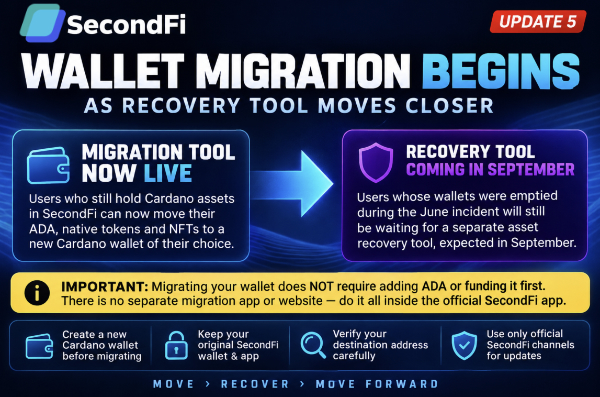
Since our last update, the SecondFi recovery process has entered another major stage. The platform has now officially begun the process of winding down, with the first version of its wallet migration tool going live for users who still have Cardano assets remaining in their SecondFi wallets.
At the same time, SecondFi has confirmed that users whose wallets were emptied during the June incident are still waiting for a separate asset recovery tool, which the company currently expects to release in September.
The migration begins //
On August 19, SecondFi announced that its wallet migration tool was officially live inside the SecondFi application. The new tool is designed for users who still hold Cardano assets within SecondFi. Rather than continuing to use the existing wallet, users can create a new Cardano wallet with a provider of their choice and migrate their remaining assets to the new wallet's destination address.
SecondFi says the migration tool moves the entire Cardano balance from the original wallet, including ADA, native tokens, and NFTs. The process is designed to handle the technical steps automatically, making it easier for users to move their remaining assets as SecondFi begins shutting down. The company is encouraging all users who still have assets in SecondFi to complete the migration, regardless of whether their wallet was affected by the June incident. SecondFi says the migration tool has also been audited by Bitdefender.
One wallet at a time //
There are several important details users should understand before beginning the migration. SecondFi says wallets must be migrated individually, and users will need to create a new Cardano wallet before starting the process. The company recommends using a hardware wallet for the new destination. If ADA is currently staked, the migration process will automatically unstake it so that the full balance can be transferred. This also means that any existing DRep delegation will end, meaning users will need to delegate to a DRep again from their new wallet if they want to continue participating in Cardano governance. SecondFi is also warning users to carefully verify their destination address before signing a transaction. Blockchain transfers cannot be reversed, and the company specifically advises users to send assets only to a Cardano wallet they control rather than an exchange deposit address. The migration tool only handles Cardano assets. Any non-Cardano assets will need to be moved separately.
Recovery is still coming //
For users whose wallets were emptied during the June incident, however, the migration tool is not the solution. SecondFi has made it clear that users who lost their assets are waiting for a separate asset recovery tool. The company currently expects that tool to become available in September. Importantly, SecondFi says that migrating remaining assets does not affect a user's recovery claim. This creates an important distinction between the two processes. Users who still have assets can now begin moving those assets away from SecondFi, while users whose wallets were drained must continue waiting for the recovery system to become available.
Do not delete your old wallet //
SecondFi continues to emphasize that users should not delete their original SecondFi wallet or the SecondFi application. According to the company, the original wallet may still be required during the asset recovery process. This means that even after migrating remaining assets, users should preserve their original wallet information and keep the application installed. For affected users who have been waiting for recovery, this remains one of the most important instructions from SecondFi.
A warning about funding //
On August 20, SecondFi issued another security notice specifically addressing the wallet migration process. The company warned users that migrating a wallet does **not** require adding ADA or funding the wallet beforehand. If a wallet does not contain enough ADA to cover network fees, SecondFi says users should **not** add funds to it. Instead, they should wait for a future version of the migration tool that will support wallets with insufficient balances. This is an important warning because the recovery process has already attracted significant attention, and SecondFi is reminding users that there is no legitimate situation where users should be asked to "top up" a wallet before migration. SecondFi also confirmed that migration takes place through an updated version of the official SecondFi application already installed by users. There is no separate migration application, standalone migration website, or new application that users need to install.
The platform winds down //
The latest announcements make the direction of SecondFi increasingly clear. The platform is no longer preparing to return to normal operations. Instead, the remaining work is focused on helping users move their assets away from SecondFi and recovering assets lost during the incident. The migration tool represents the beginning of that final transition. For users with remaining balances, there is now a path forward. For users whose wallets were drained, the next major milestone will be the release of the asset recovery tool expected in September.
What happens next //
The next major development will likely be the recovery tool itself. SecondFi has not yet provided a specific September release date, so affected users are still waiting for further instructions and confirmation of exactly how the recovery process will work. Until then, SecondFi continues to advise users to preserve their original wallets, retain the application, and follow only official instructions. The migration process also serves as another reminder that users should be extremely cautious about anyone claiming to offer an alternative recovery method, requesting funds, or directing users toward unofficial applications or websites. As SecondFi moves toward the final stages of its existence, the focus is now firmly on two things: safely moving assets that remain and recovering what was lost. For those still holding assets, migration has begun. For those who lost everything, September may be the next major turning point.
We are continuing to monitor the situation and will share another update as soon as SecondFi releases more information.
Latest from SecondFi on X: //
On August 19, SecondFi announced that its Wallet Migration Tool was officially live inside the SecondFi application. The tool allows users who still hold Cardano assets to move their ADA, native tokens, and NFTs to a newly created Cardano wallet. SecondFi encouraged all remaining users to migrate their assets as the platform winds down. SecondFi also confirmed that wallets emptied during the incident will require a separate Asset Recovery Tool, which is currently expected to become available in September. The company stated that migrating remaining assets does not affect an existing recovery claim.
On August 20, SecondFi issued a security notice warning users that the migration process never requires adding ADA or funding a wallet first. Users whose wallets do not contain enough ADA for network fees are being instructed to wait for a future version of the migration tool rather than adding funds. SecondFi also reiterated that migration occurs through an updated version of the official SecondFi application and that users should not use separate migration applications or websites.
Wrap up //
SecondFi has now moved beyond preparation and into the actual wind-down of the platform. The Wallet Migration Tool is live for users who still have Cardano assets, while a separate recovery tool for wallets drained during the June incident is expected in September. The situation has entered a new phase: remaining assets can now begin moving out, while affected users wait for the recovery process to take its next step.
The story is not over yet. We are monitoring this closely and will continue sharing updates as more information becomes available. Subscribe to stay informed.
Original: SecondFi / Yoroi Wallet Drain
UPDATE 2: SecondFi / Yoroi Wallet Drain
UPDATE 3: SecondFi / Yoroi Wallet Drain
UPDATE 4: SecondFi / Yoroi Wallet Drain
Since our last update, the SecondFi recovery process has entered another major stage. The platform has now officially begun the process of winding down, with the first version of its wallet migration tool going live for users who still have Cardano assets remaining in their SecondFi wallets.
At the same time, SecondFi has confirmed that users whose wallets were emptied during the June incident are still waiting for a separate asset recovery tool, which the company currently expects to release in September.
The migration begins //
On August 19, SecondFi announced that its wallet migration tool was officially live inside the SecondFi application. The new tool is designed for users who still hold Cardano assets within SecondFi. Rather than continuing to use the existing wallet, users can create a new Cardano wallet with a provider of their choice and migrate their remaining assets to the new wallet's destination address.
SecondFi says the migration tool moves the entire Cardano balance from the original wallet, including ADA, native tokens, and NFTs. The process is designed to handle the technical steps automatically, making it easier for users to move their remaining assets as SecondFi begins shutting down. The company is encouraging all users who still have assets in SecondFi to complete the migration, regardless of whether their wallet was affected by the June incident. SecondFi says the migration tool has also been audited by Bitdefender.
One wallet at a time //
There are several important details users should understand before beginning the migration. SecondFi says wallets must be migrated individually, and users will need to create a new Cardano wallet before starting the process. The company recommends using a hardware wallet for the new destination. If ADA is currently staked, the migration process will automatically unstake it so that the full balance can be transferred. This also means that any existing DRep delegation will end, meaning users will need to delegate to a DRep again from their new wallet if they want to continue participating in Cardano governance. SecondFi is also warning users to carefully verify their destination address before signing a transaction. Blockchain transfers cannot be reversed, and the company specifically advises users to send assets only to a Cardano wallet they control rather than an exchange deposit address. The migration tool only handles Cardano assets. Any non-Cardano assets will need to be moved separately.
Recovery is still coming //
For users whose wallets were emptied during the June incident, however, the migration tool is not the solution. SecondFi has made it clear that users who lost their assets are waiting for a separate asset recovery tool. The company currently expects that tool to become available in September. Importantly, SecondFi says that migrating remaining assets does not affect a user's recovery claim. This creates an important distinction between the two processes. Users who still have assets can now begin moving those assets away from SecondFi, while users whose wallets were drained must continue waiting for the recovery system to become available.
Do not delete your old wallet //
SecondFi continues to emphasize that users should not delete their original SecondFi wallet or the SecondFi application. According to the company, the original wallet may still be required during the asset recovery process. This means that even after migrating remaining assets, users should preserve their original wallet information and keep the application installed. For affected users who have been waiting for recovery, this remains one of the most important instructions from SecondFi.
A warning about funding //
On August 20, SecondFi issued another security notice specifically addressing the wallet migration process. The company warned users that migrating a wallet does **not** require adding ADA or funding the wallet beforehand. If a wallet does not contain enough ADA to cover network fees, SecondFi says users should **not** add funds to it. Instead, they should wait for a future version of the migration tool that will support wallets with insufficient balances. This is an important warning because the recovery process has already attracted significant attention, and SecondFi is reminding users that there is no legitimate situation where users should be asked to "top up" a wallet before migration. SecondFi also confirmed that migration takes place through an updated version of the official SecondFi application already installed by users. There is no separate migration application, standalone migration website, or new application that users need to install.
The platform winds down //
The latest announcements make the direction of SecondFi increasingly clear. The platform is no longer preparing to return to normal operations. Instead, the remaining work is focused on helping users move their assets away from SecondFi and recovering assets lost during the incident. The migration tool represents the beginning of that final transition. For users with remaining balances, there is now a path forward. For users whose wallets were drained, the next major milestone will be the release of the asset recovery tool expected in September.
What happens next //
The next major development will likely be the recovery tool itself. SecondFi has not yet provided a specific September release date, so affected users are still waiting for further instructions and confirmation of exactly how the recovery process will work. Until then, SecondFi continues to advise users to preserve their original wallets, retain the application, and follow only official instructions. The migration process also serves as another reminder that users should be extremely cautious about anyone claiming to offer an alternative recovery method, requesting funds, or directing users toward unofficial applications or websites. As SecondFi moves toward the final stages of its existence, the focus is now firmly on two things: safely moving assets that remain and recovering what was lost. For those still holding assets, migration has begun. For those who lost everything, September may be the next major turning point.
We are continuing to monitor the situation and will share another update as soon as SecondFi releases more information.
Latest from SecondFi on X: //
On August 19, SecondFi announced that its Wallet Migration Tool was officially live inside the SecondFi application. The tool allows users who still hold Cardano assets to move their ADA, native tokens, and NFTs to a newly created Cardano wallet. SecondFi encouraged all remaining users to migrate their assets as the platform winds down. SecondFi also confirmed that wallets emptied during the incident will require a separate Asset Recovery Tool, which is currently expected to become available in September. The company stated that migrating remaining assets does not affect an existing recovery claim.
On August 20, SecondFi issued a security notice warning users that the migration process never requires adding ADA or funding a wallet first. Users whose wallets do not contain enough ADA for network fees are being instructed to wait for a future version of the migration tool rather than adding funds. SecondFi also reiterated that migration occurs through an updated version of the official SecondFi application and that users should not use separate migration applications or websites.
Wrap up //
SecondFi has now moved beyond preparation and into the actual wind-down of the platform. The Wallet Migration Tool is live for users who still have Cardano assets, while a separate recovery tool for wallets drained during the June incident is expected in September. The situation has entered a new phase: remaining assets can now begin moving out, while affected users wait for the recovery process to take its next step.
The story is not over yet. We are monitoring this closely and will continue sharing updates as more information becomes available. Subscribe to stay informed.
Original: SecondFi / Yoroi Wallet Drain
UPDATE 2: SecondFi / Yoroi Wallet Drain
UPDATE 3: SecondFi / Yoroi Wallet Drain
UPDATE 4: SecondFi / Yoroi Wallet Drain





×
SUBSCRIBE TO SESSION ///
Catch the freshest Session sent straight to your inbox as soon as it's dropped!
Catch the freshest Session sent straight to your inbox as soon as it's dropped!